
Track Revenue, Cost, Utilization, Profitability
PROJECT FINANCE
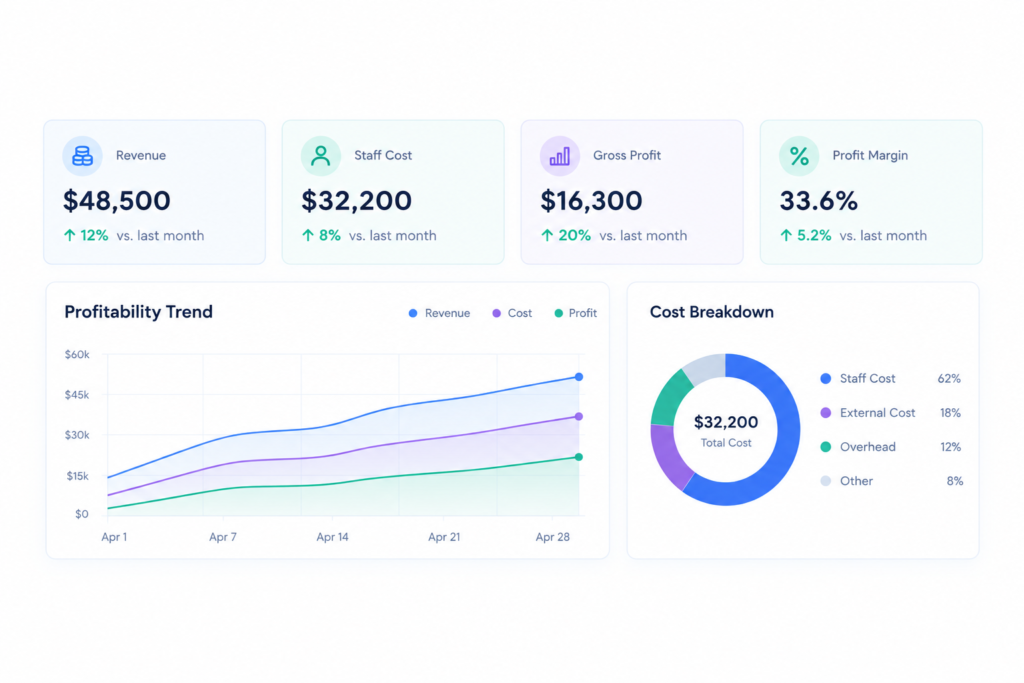
Project Finance is the financial layer of the SaralFlow platform. It connects billing rates, staff cost, and project commercials to the time already captured in Project Essential, so you always know how much a project is worth, what it costs to deliver, and whether it is actually profitable.
Know where every project stands.
The Business Challenge
Hours tracked is not the same as money understood
Most service companies can answer how many hours were logged on a project. Far fewer can answer what those hours are actually worth.
Why it happens
Time tracking tells you what happened operationally. It does not tell you what that means financially. Billing rates, staff cost, and commercial terms usually live somewhere else entirely, disconnected from the hours being logged.
Project Finance connects billing rates, staff cost, and commercials to the project activity already captured in Project Essential, so financial performance is something you can see, not something you calculate after the fact.
What typically happens
Billing rates live in a spreadsheet someone updates when they remember to
Staff cost is treated as just a salary number, not the full cost of delivery
Revenue and profitability get calculated manually at month end, if at all
Client-approved hours move to invoicing through email threads
A project can look fine on hours and still be losing money.
Solution
How Project Finance helps?
One connected record, from delivery through financial performance
Project Finance is an add-on to Project Essential, not a standalone application. It extends the operational data Project Essential already captures.
Project Finance: Billing rates, staff costing, commercials, pre-invoicing, revenue, utilization, and profitability.
Project Finance does not currently include invoicing itself. Pre-invoicing prepares client-approved project effort for your organization’s downstream billing process.
Set Rates
Track Cost
Define Commercials
Pre-Invoice
Track Utilization
Measure Profitability
Who Project Finance Is Built For
Project Finance is built for organizations where staff time, project delivery, and commercial value directly determine revenue and profitability:
- IT services
- Software development companies
- Consulting firms
- Digital agencies
- Engineering services companies
- Professional services organizations
If your business needs to know what a project is actually earning, what it costs to deliver, and whether it is profitable, this is what Project Finance is built to answer.

Capabilities
Everything you need for Financial Management
Billing Rates and Billing Profiles
Maintain consistent, accurate billing rates without a spreadsheet
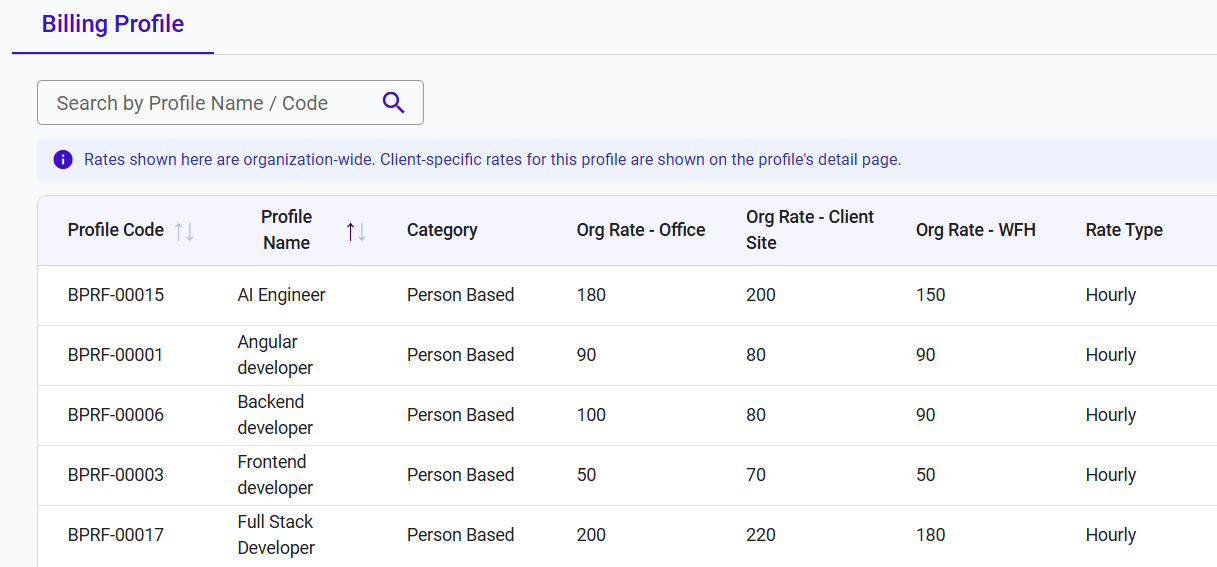
Every hour logged against a project needs to translate into a rate. Getting that translation wrong, or letting it go stale, is one of the most common ways revenue gets miscalculated.
- Manage rates through Billing Profiles:
- Reusable billing profiles by role, seniority, or project type
- Default billing profile assignment at the organization level
- Effective-dated rate changes, so historical rates stay accurate
Why effective dating matters
Rates change. A senior engineer's billing rate today is not necessarily what it was six months ago. Without effective dating, a rate change either gets applied retroactively by mistake, or the old rate keeps getting used long after it should have changed.
Business outcome
Keep billing rates accurate and current, so revenue calculations reflect what was actually agreed, not what a spreadsheet says today.
Staff Costing
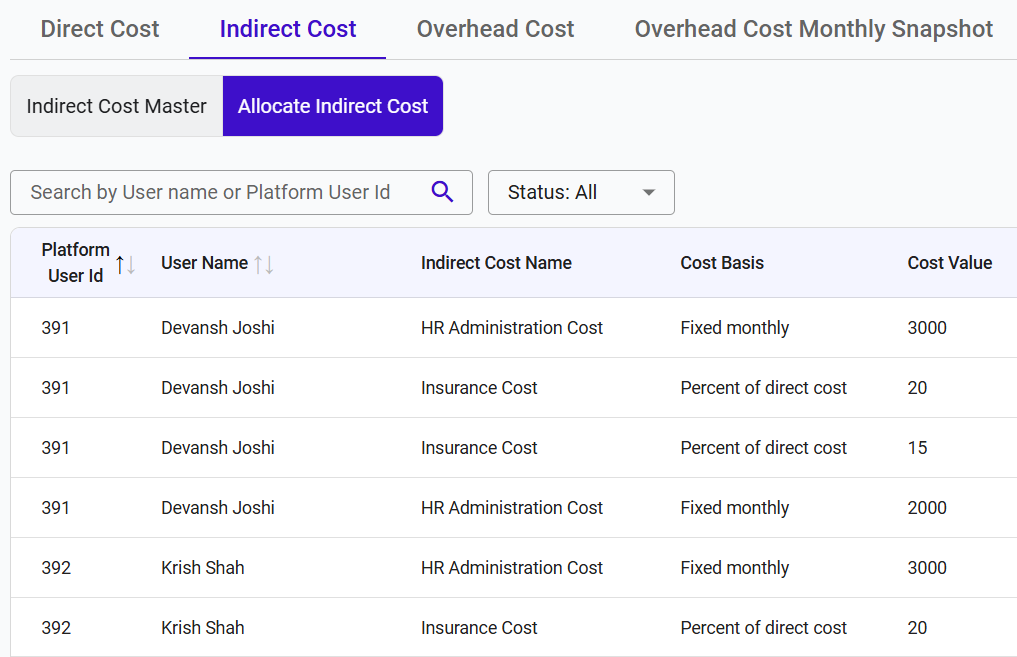
Understand the real cost of delivering project work, not just a salary number
What a staff member is paid is only part of what it costs to have them on a project.
- Build cost from three components:
- Direct cost
- Indirect cost
- Overhead allocation
Why the full picture matters
A project can look profitable if you only account for direct salary cost, and lose money once indirect and overhead costs are factored in. Most spreadsheet-based tracking stops at direct cost because that is the number that is easiest to get.
Business outcome
See the true cost of project delivery, so profitability reflects reality instead of a partial calculation.
Project Commercials
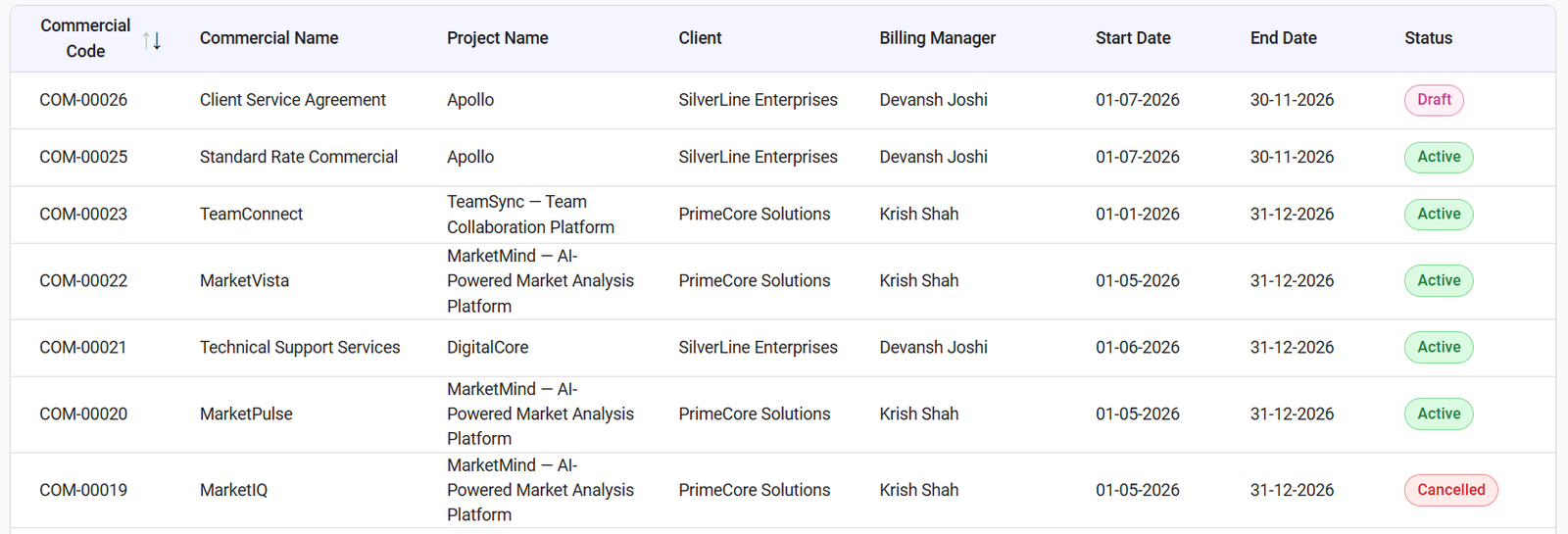
Keep contract value, dates, and currency connected to the project they belong to
Commercial terms are usually the first thing to drift out of sync with the operational side of a project.
- Track commercial information per project:
- Contract value
- Contract start and end dates
- Currency
- Client-specific commercial details
Why this matters
When commercial terms sit in a separate document from the project they apply to, someone has to remember to cross-check them. Keeping commercials attached to the project means the numbers used for revenue and profitability are always working from the same source.
Business outcome
Keep commercial terms connected to project activity, so financial calculations are working from current, accurate information.
Pre-Invoicing
Move client-approved hours through a structured review before billing
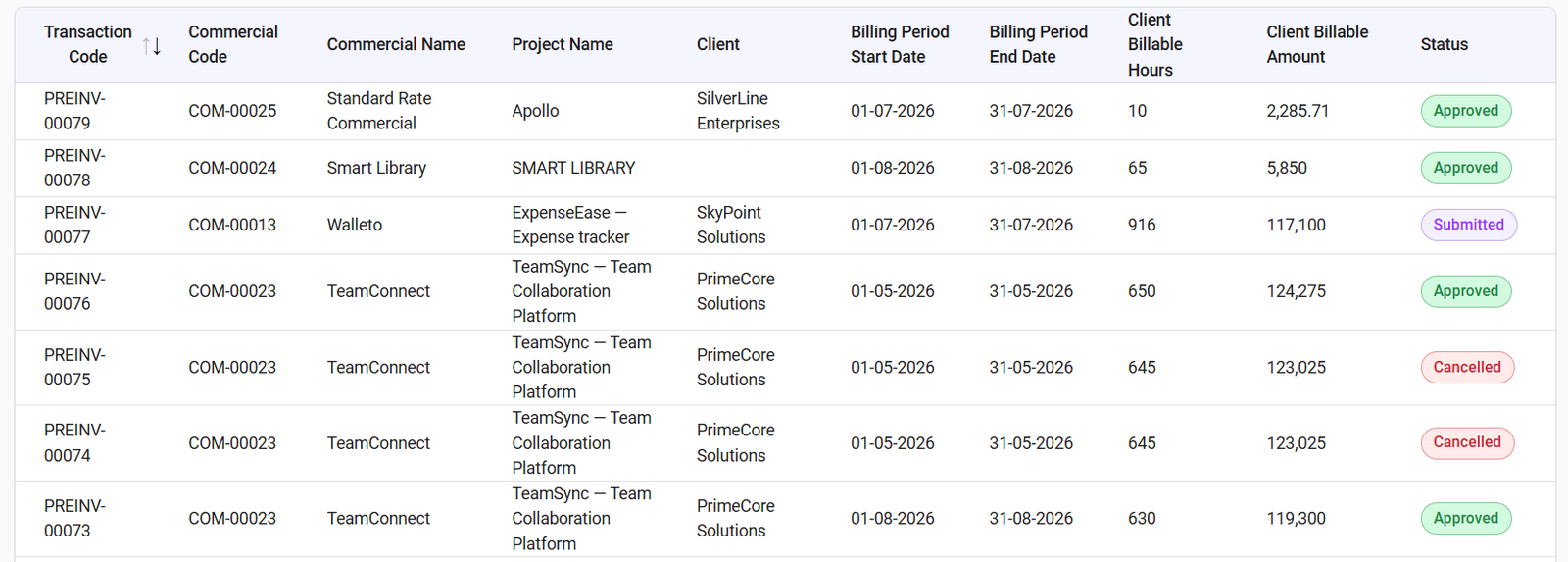
Business outcome
Reduce billing errors by reviewing client-approved hours before they reach your invoicing process, not after.
Approved hours do not automatically mean invoice-ready hours. Something usually needs to happen in between.
- Structure the review process:
- Capture client-approved hours from approved project activity
- Route hours through an internal review step
- Prepare reviewed hours for your downstream billing process
Why it matters
Without a structured step here, this review happens over email, if it happens at all, and it is easy for hours to reach invoicing without anyone actually confirming they should. Pre-invoicing does not replace your invoicing system. It makes sure what reaches that system has already been checked.
Revenue Tracking
See what a project is generating, not just what it might generate
Revenue on a project is not one static number. It changes as work progresses.
- Track revenue at the project level:
- Expected project revenue, based on commercials and billing rates
- Realized revenue, based on approved time and applicable rates
- Revenue trends as the project moves forward
Why the distinction matters
Expected revenue tells you what a project could be worth if everything goes to plan. Realized revenue tells you what it is actually worth right now. A project manager or finance lead needs both, because the gap between them is often the first sign something is off.
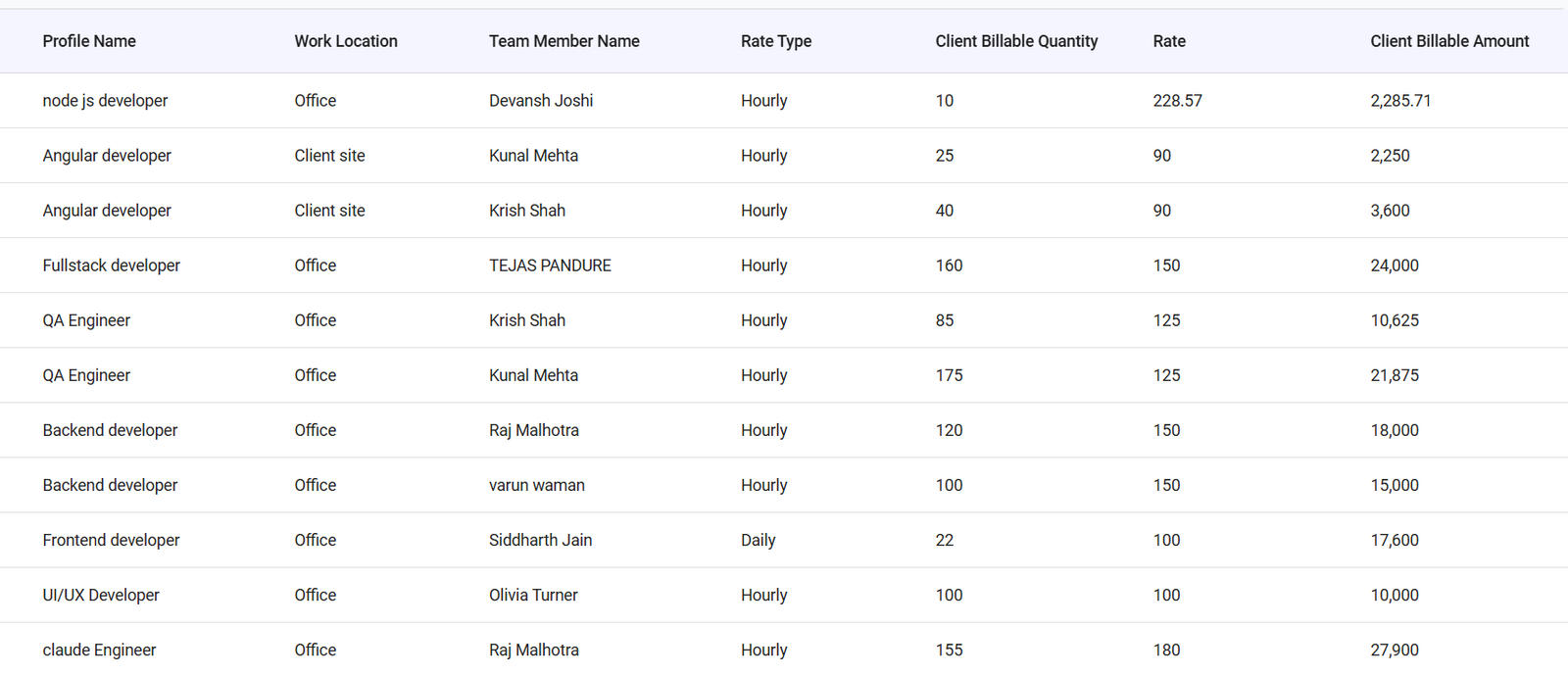
Business outcome
Track revenue as it is actually being generated, so expected and realized numbers can be compared instead of assumed to match.
Financial Utilization
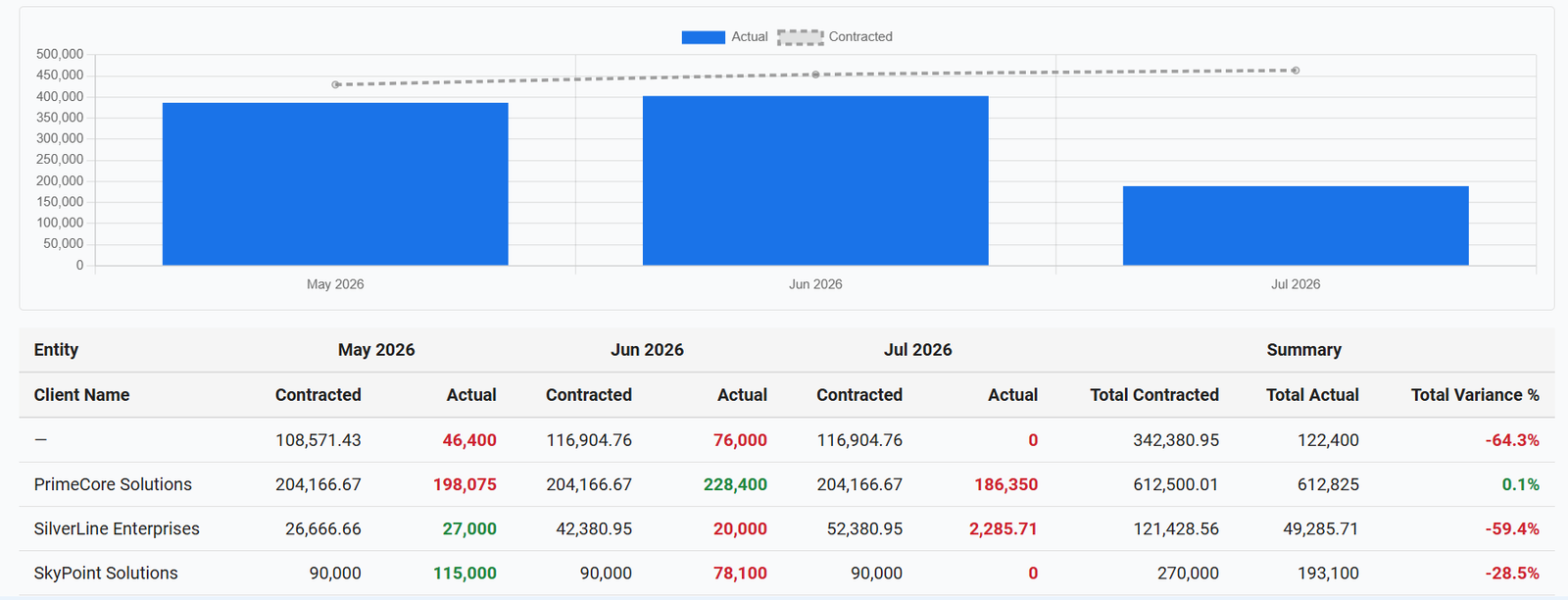
Business outcome
Understand how much of a project's financial capacity has actually been used, so utilization reflects value, not just time.
Measure how much of a project’s financial capacity has been used, not just how many hours
Traditional utilization looks at hours used against hours planned. That is useful, but it is not the full story for a service business.
- Understand utilization in financial terms:
- Commercial value used against total contract value
- Utilization by billing profile, not just by headcount
- A different picture than hours-based utilization alone can provide
Why it matters
A project can be at 80 percent of its planned hours and nowhere near 80 percent of its financial value, if the mix of senior and junior staff working those hours does not match what was planned. Hours-based utilization would miss this. Financial utilization would not.
Profitability
Compare what a project earns against what it costs, while the project is still active
This is where revenue and cost come together into a single answer.
- Compare project financial performance:
- Project revenue against project cost
- Profitability by project, client, or engagement type
- Margin trends over the life of a project
Why timing matters here too
A project running below margin at the halfway point is something a project manager or finance lead can still act on. The same project discovered to be unprofitable after it closes is simply a loss to record. The value is in seeing it early enough to do something about it.
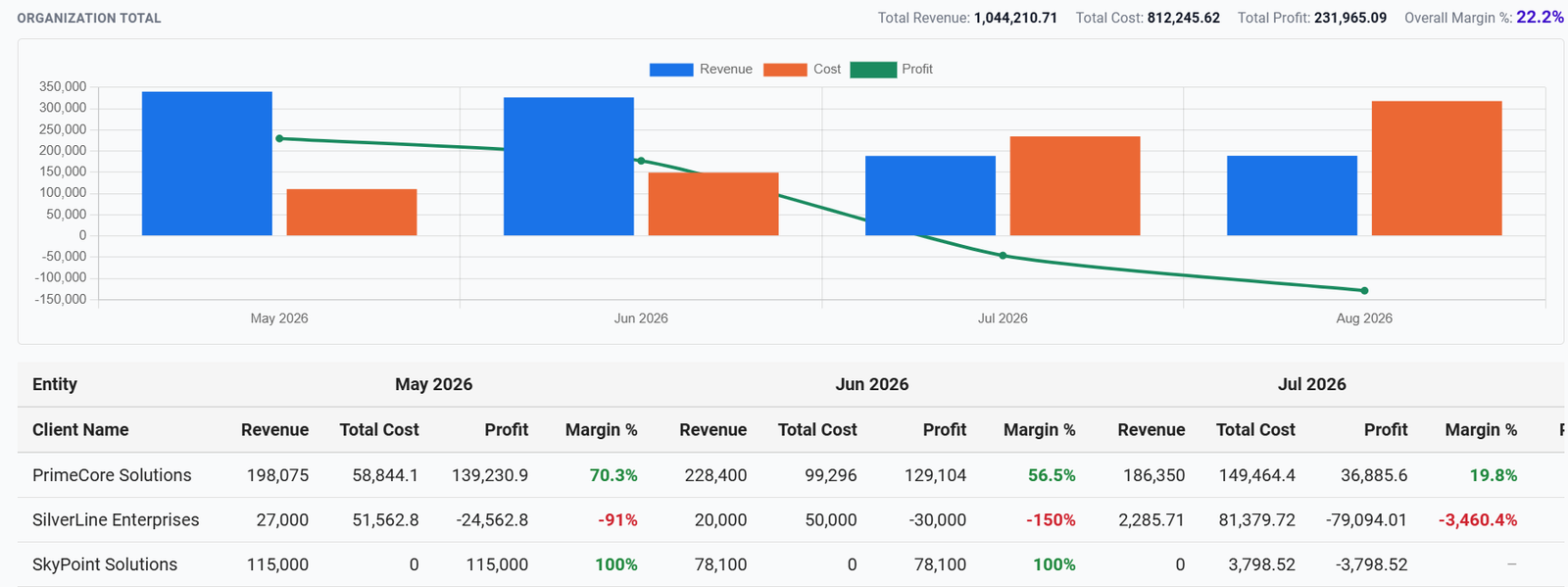
Business outcome
Understand project profitability while there is still time to respond, instead of finding out at project close.
Built for every Team involved in Project Financials
Project Finance is used differently depending on where you sit in the organization.
Everyone works from the same underlying financial record. Nobody is reconciling their version of the numbers against someone else’s.
- Project Managers
- Finance Teams
- Billing Managers
- Business Leaders
- Operations and PMO





Frequently Asked Questions
Project Finance is used to manage billing rates, track staff cost, maintain project commercials, review client-approved hours before billing, and understand project revenue, utilization, and profitability. It gives service companies a connected financial view of project performance, built on top of the operational data already captured in Project Essential.
No. Project Finance is an add-on to Project Essential and uses the project and time data already maintained there. It is not replacement for project management or timesheet tracking.
No. Project Finance includes pre-invoicing, which captures client-approved hours and moves them through an internal review before they proceed to your organization's downstream billing process. It does not generate invoices itself.
Staff cost combines direct cost, indirect cost, and overhead allocation, rather than relying on salary alone. This gives a more complete view of what it actually costs to deliver project work.
Yes. Financial utilization looks at how much of a project's commercial value has been used, based on billing rates and the mix of staff involved, rather than hours alone. A project can be on track by hours and off track financially, or the other way around.
Billing profiles support effective-dated rates. When a rate changes, the new rate applies going forward while historical rates are preserved, so past revenue calculations stay accurate.
Access is controlled through dedicated financial roles: Global Administrator, Financial Administrator, Costing Administrator, Billing Profile Administrator, and Billing Administrator. A Billing Administrator assigned to a specific project is called a Billing Manager, and can only manage commercials and pre-invoicing for that project. Not every staff member needs, or gets, financial access.
Yes. Project Finance builds directly on the approved time and project data captured in Project Essential. It does not require re-entering project or staffing information separately.
Service-based organizations where staff time, project delivery, and commercial value directly affect revenue: IT services, consulting firms, digital agencies, engineering services, and other professional services organizations.
- Project Finance
See What Your Projects Are Really Making
Know the revenue, cost, and profitability behind every project, while there is still time to act on it